

Dronefare Weekly Drone Dispatch
Welcome to the Drone Dispatch, your dedicated source for staying ahead in the rapidly evolving world of drones and drone warfare. This newsletter brings together the latest developments in drones and drone warfare, from cutting-edge technology and tactical innovations to global military applications and policy shifts. Each dispatch is designed to provide a clear and concise overview of how drones are shaping modern conflict, international and domestic security, and strategy.

Executive Summary
Ukraine pushed long-range strikes deeper into Russia while Russia hammered Kyiv with mass Shahed drones, killing civilians and igniting fires in residential towers.
Moscow’s region saw rare impact damage from a Ukrainian drone, injuring five and forcing airport closures across the capital area.
In Sudan, the RSF used drones to threaten Khartoum’s airport reopening, striking for several consecutive days.
Europe moved from concept to action on its “drone wall”, while the Nordic bloc launched a joint procurement pact.
The U.S. Army accelerated counter-UAS and munition buys, awarding Anduril a C-UAS network upgrade and seeking fire-and-forget drone munitions. At the same time, AeroVironment secured a $95.9 M next-gen missile contract.
Industry sprinted forward: Lockheed’s Vectis, Shield AI’s xBAT, Baltimore’s GARC boats, and China’s DeepSeek swarms all made headlines.
Drone Warfare
Kyiv Burns in Overnight Strike
On October 26, 2025, drones set two residential buildings ablaze in Kyiv’s Desnianskyi district, killing three and injuring 29–32. The attack adds pressure on Ukraine’s air-defense networks.
Rare Impact Near Moscow
On October 24, 2025, a Ukrainian drone struck a high-rise in Krasnogorsk, injuring five, including a child. An additional video confirmed the Krasnogorsk strike, showing shattered windows and debris. Civilian-zone vulnerability this close to the Kremlin complicates Russia’s internal security narrative.
Ukrainian Drones Target Moscow
On October 27, 2025, dozens of UAVs targeted the capital, diverting flights at Domodedovo and Zhukovsky; Russia claimed to shoot down over 190. Such saturation raids signal Ukraine’s evolving capacity to stress Russian defenses through volume tactics.
Romania Scrambles on the Danube
On October 22, 2025, Romania launched F-16s as Russian drones struck near the Danube border. The quick response underscores NATO’s heightened readiness and the risk of spill-over incidents across Eastern Europe.
Sudan: RSF Drones Threaten Airport Reopening
Between October 21 and 24, 2025, RSF drone attacks around Khartoum delayed or disrupted the airport’s reopening. The persistence of these strikes shows how unmanned systems can entrench power asymmetries in fragile post-conflict states.
Two Ukrainian Journalists Killed
On October 23, 2025, a Russian Lancet struck a press-marked car near Kramatorsk, killing a reporter and cameraman. This demonstrates how precision loitering munitions can be repurposed to suppress documentation of war crimes.
Russia’s Overnight Barrages Continue
On October 25–26, 2025, multiple waves of Shahed drones and missiles killed at least four people across Ukraine. The hybrid use of cheap drones with expensive missiles reflects Russia’s asymmetric strategy to exhaust Ukraine’s interceptors.
Cartel Drone Warfare Spreads
On October 24, 2025, a Tijuana drone attack hinted at cartels adopting FPV and bomb-drop tactics seen in Ukraine. The spread of battlefield know-how to organized crime signals a dangerous democratization of aerial lethality.
Japan Intercepts Russian Bombers
On October 24, 2025, Japan scrambled fighters after Tu-95 bombers approached its airspace, demonstrating that conventional and unmanned threats are converging in regional security calculations.
Russia Disruptions & Retaliation
On October 26, 2025, Ukraine’s deep-strike drone attacks occasionally disrupted Russian internet service. The fusion of cyber and kinetic effects marks a new form of multi-domain pressure.
Drone Policy & Regulation
EU’s ‘Drone Wall’ Shapes Up
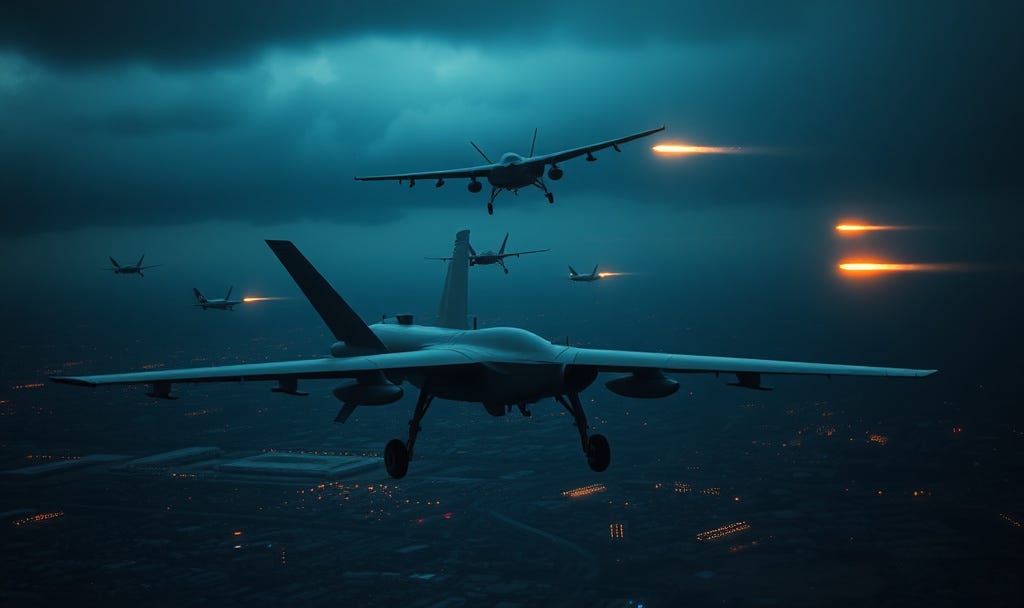
Brussels advanced its “drone wall” — a network of sensors, EW, and jammers across EU borders. The plan represents Europe’s first integrated shield against low-cost unmanned incursions.
Nordic Joint Procurement
Finland, Sweden, Norway, and Denmark signed a technical pact to co-develop and purchase UAS. Shared procurement could unify standards and give small states leverage against large suppliers.
U.S. Carrier to South America
The U.S. deployed the USS Gerald R. Ford to Latin America amid tensions over maritime drones. Its presence reflects the growing overlap between naval and unmanned deterrence missions.
U.S. sanctions on Russian oil firms
New U.S. sanctions on Russian oil firms coincided with escalating drone duels. Economic and technological containment are increasingly fused instruments of pressure.
Romania’s Air Policing
Repeated scrambles show how drone incidents have normalized constant air-defense readiness across NATO’s eastern flank.
Drone Technology & Innovation
Anduril to Modernize C-UAS Network
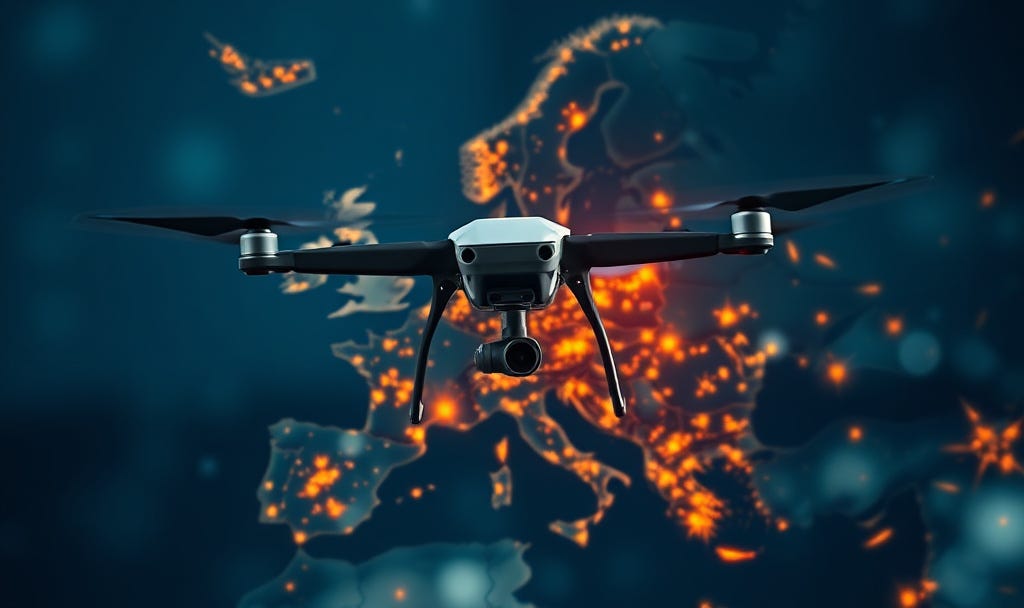
The U.S. Army tapped Anduril to upgrade its counter-UAS network, integrating AI detection with kinetic interceptors. This illustrates the military’s pivot to software-defined defense layers.
Army Wants Fire-and-Forget Drone Munitions
A solicitation for new drone munitions seeks fire-and-forget capabilities beyond 4 km. The move accelerates autonomy at the tactical edge, reducing operator workload.
AeroVironment Wins Next-Gen C-UAS Missile
AeroVironment earned a $95.9 M contract for FE-1 counter-drone missiles. This underscores the industrial rush to dominate short-range air-defense niches.
Lockheed’s Vectis Debuts
Lockheed unveiled the Vectis drone, a CCA-class UAV designed to team with the F-35. Its modular design signals a new phase of manned-unmanned integration.
Shield AI’s xBAT ‘Fighter Drone’
The AI-piloted xBAT shows real-time autonomy in contested environments. It’s a tangible step toward scalable, self-directing combat systems.
Terminator-Gun ‘Drone Killer’
Ukraine refitted a minigun turret into a vehicle-mounted anti-drone gun. The adaptation demonstrates how field innovation can outpace traditional procurement cycles.
Baltimore’s Drone Boats Scale Up
BlackSea’s GARC boats now roll off U.S. lines at an industrial pace, blending naval and unmanned production cultures. Maritime drones are emerging as key deterrence tools.
IRIS Radar Upgrade
An upgraded IRIS radar tripled detection range for Shaheds, sharpening Europe’s defensive edge. Continuous sensor evolution is proving as vital as kinetic interception.
Australia’s Drone Industry Soars
Rising war demand is propelling Australian drone firms. The surge positions Australia as a critical secondary supplier in Western drone ecosystems.
China’s DeepSeek and Autonomy
The PLA is testing DeepSeek-powered swarms combining drones and robotic ground units. This marks a frontier where AI could outperform human command loops.
Africa’s Critical-Infrastructure Drones
A Nigerian startup aims to protect power and mining assets with defensive drones. The trend shows how emerging markets are localizing security tech for infrastructure defense.
Western Drones Underperform in Ukraine
Frontline troops told The Economist that many Western drones are costly and fragile compared to Russian EW. The critique may reshape future NATO acquisition priorities toward expendability.
Analysis
Two arcs defined the week. First, the infrastructure war: Ukrainian long-range strikes kept pressure on Russian logistics while Russia’s Shahed barrages devastated cities like Kyiv. Second, the institutional response: Europe’s drone wall, Nordic procurement pact, and U.S. defense-industrial acceleration signaled a move from pilot programs to permanent infrastructure. The tech front favored modular, scalable systems — from Vectis to xBAT — while conflicts in Sudan and Latin America showed how fast drones are permeating new theaters.
Outlook
Expect continued energy-node strikes and urban-center incursions through winter. Europe’s “drone wall” will ignite debates over air-space sovereignty, while U.S. and NATO programs push toward 2026 mass-production milestones.
What to Watch
Watch China’s DeepSeek autonomy and Australia’s industry surge as barometers of global drone industrialization.
Monitor the rollout of DeepSeek-powered systems by People’s Liberation Army (PLA), especially platforms combining robot-dogs and drone swarms for autonomous reconnaissance and strike roles.
Track China’s procurement of domestic AI chips (e.g., from Huawei Technologies) versus imports such as NVIDIA hardware — an indicator of how Beijing may bypass export controls to accelerate advanced UAS capabilities.
Watch for operational employment: patents and tenders hint at swarms that can “see-track-coordinate” with little human control. If these move from the lab to the field, unmanned massed systems could reshape frontline warfare.
Thanks for reading Dronefare’s Weekly Drone Dispatch. Follow us on LinkedIn and subscribe to stay up-to-date on the latest developments in drone warfare.